
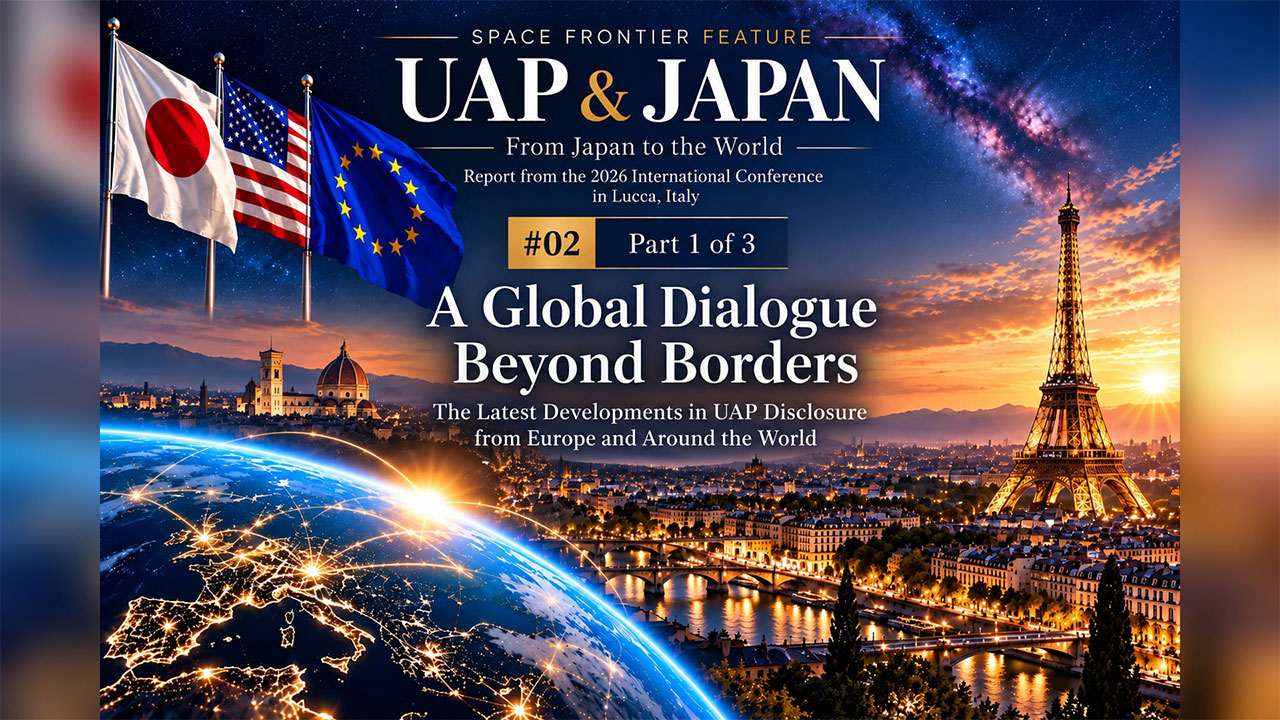
Where Global Experts Stand on UAP Disclosure
Reporting: Lucca, Italy, 10-11 October 2026
Reported and written by Ryoko Kuwata (SPACE FRONTIER)
UAP Experts from Around the World Gather in Lucca, Italy
On October 10–11, 2026, the historic Tuscan city of Lucca hosted the WORLD SUMMIT UFO/UAP, an international conference devoted to unidentified anomalous phenomena (UAP) and UFOs.
The event took place at the Grand Hotel Guinigi in Lucca. Researchers, former government officials, journalists and policy figures attended from the United States, France, Italy, Japan, China, Norway, Germany, Portugal, Switzerland, Argentina and other countries.
A central theme was the growing international reach of “disclosure”—the debate over how governments investigate and release information about UAP, a discussion that has gathered momentum particularly in the United States.
UAP stands for Unidentified Anomalous Phenomena. The term encompasses the traditional idea of unidentified flying objects (UFOs) while providing a broader framework for phenomena that cannot readily be explained by currently available information.
In recent years, UAP discussions have expanded to encompass aviation safety, national security, scientific investigation, government transparency and international cooperation. In the United States, congressional hearings, defense investigations and the development of reporting procedures have brought the subject into the sphere of formal public policy.
Importantly, the reporting of unexplained phenomena must be distinguished from scientific proof that their origins are extraterrestrial life or technology.
Against this complex backdrop, the Lucca gathering provided a forum for considering these issues through perspectives and experiences extending beyond the United States.
Italy’s UFO Research History and the Background to the Conference
Italy has a long history of independent UFO research in Europe. One of its prominent organizations is the Centro Ufologico Nazionale (CUN), established in 1967.
Despite a name sometimes translated in ways that suggest an official national institution, CUN is not an agency of the Italian government. It is a private research organization that has long collected and studied UFO-related reports and documents, published research, and fostered international exchanges.
Its president, Roberto Pinotti, is an Italian UFO researcher and author. He also serves as president of the International Coalition for Extraterrestrial Research (ICER), an international research network.
The neighboring Republic of San Marino previously hosted 34 international symposia on UFOs. In 2026, the temporary unavailability of the customary venue was part of the background to the planning of a separate international event in Lucca.
The Lucca event was planned and operated by a private Italian company, with Pinotti serving as an unpaid adviser. CUN and ICER also supported the initiative as organizations. Crucially, the Lucca conference was independently organized and had no direct operational relationship with the 34 earlier San Marino symposia.
Pinotti participated as a speaker and expressed his view that international efforts toward UAP disclosure should be advanced.
Experts from the United States, Europe and Asia
A defining feature of the conference was the range of countries and disciplines represented.
From the United States came Luis Elizondo, a former Department of Defense official known internationally for his statements and writing on UAP and government disclosure. He has been a prominent figure in public discussions of U.S. government UAP investigations.
Retired U.S. Air Force Captain Robert Salas also attended. For decades, he has spoken publicly about a reported UFO-related incident at a U.S. nuclear missile facility in 1967.
Don Schmitt, associated with the U.S. UFO research organization CUFOS, is known for his investigations and books on the 1947 Roswell incident.
From France came Jean-Jacques Velasco, who previously headed GEPAN and SEPRA, government-linked UFO investigation units within the French space agency CNES. France’s long-running institutional investigation of unidentified aerospace phenomena offers a valuable comparison of government research systems.
Peter Skafish, an anthropologist and co-founder of the U.S.-based Sol Foundation, also participated. His work approaches UAP not only through science and technology, but also in relation to human societies, culture and ideas.
Other European participants included Erling Strand, who studies Norway’s Hessdalen phenomena; German journalist Robert Fleischer; Francisco Mourão Corrêa of Portugal; and Guido Ferrari of Switzerland.
Also among those listed were Fabio De Masi, a former member of the European Parliament; Yan Jin of China; Andrea Pérez Simondini of Argentina; and Father Gianfranco Basti of the Pontifical Lateran University. Italian participants also included retired naval officer Clarbruno Vedruccio.
These participants have different professional backgrounds and affiliations, spanning government agencies, research institutions, universities and private organizations. An individual’s institutional background should not be confused with authorization to represent a government officially.
Their presence illustrated how UAP discussions now extend well beyond any single country or research community.
Participation from Japan: A Connection to International Debate
Japan was represented at the conference by Yoshiharu Asakawa, a former member of the House of Representatives and an assistant to the chair of the cross-party Parliamentary League for the Investigation of Unidentified Anomalous Phenomena from a National Security Perspective (commonly known in Japan as the “UFO Parliamentary League”). Ryo Kikuchi attended as his interpreter.
The parliamentary league is chaired by former Minister of Defense Yasukazu Hamada. It has discussed UAP from a national security perspective, including government information gathering, investigative arrangements and international cooperation.
In recent years, Japanese lawmakers have increasingly discussed aviation safety, national security responses and mechanisms for collecting and investigating UAP reports. In September 2026, lawmakers from Japan and the United States issued a joint statement calling for UAP-related information sharing and cooperation, another indication of cross-border parliamentary engagement.
Participation in international meetings can provide opportunities for Japanese representatives to exchange views directly with specialists and counterparts from other countries.
For Japan, the priority should not be to accept overseas UAP claims uncritically. It is to examine what other governments investigate, what information they release, how they conduct scientific verification, and what lessons can inform Japan’s own security and science policies. Developing an appropriate domestic framework is an important task.
The Lucca conference offered one opportunity to broaden Japan’s connections with these international discussions.
What Does “Disclosure” Actually Mean?
“Disclosure,” a central theme of the conference, is sometimes used to mean a government announcement confirming the existence of UFOs or extraterrestrial life. Viewed through policy and science, however, disclosure involves several distinct stages and meanings.
These include ensuring that pilots and military personnel can properly report sightings; scientifically analyzing collected data; releasing information that can be made public while protecting legitimate security secrets; and clearly communicating both what has been established and what remains unknown.
Official government investigations, independent research, individual testimony, hypotheses and speculation all involve different kinds of evidence. Keeping those distinctions clear is essential to a meaningful public-policy discussion of UAP.
At the Lucca conference, speakers argued that UAP disclosure efforts, which have largely been driven by developments in the United States, should become a broader international undertaking in which other countries play active roles.
In a post-conference assessment, Pinotti likewise expressed the view that disclosure should be pursued globally rather than solely within the United States.
At the same time, differences among national systems, disclosure rules and scientific methods present practical challenges to international cooperation.
An Exclusive Interview with Luis Elizondo
SPACE FRONTIER covered the Lucca conference on location, documenting discussions among international specialists and broader developments in UAP research and policy.
We also conducted an individual interview with Luis Elizondo, the former U.S. Department of Defense official who has become internationally known for his role in the debate over UAP disclosure.
The approximately 50-minute interview was recorded as a joint reporting project with French science journalist Charles-Maxence Layet. Publication is planned for a later date.
SPACE FRONTIER will continue to report on developments in UAP science, policy, national security and transparency through international conference coverage and interviews, bringing multiple perspectives to readers in Japan and beyond.
What Can Japan Learn from the Global UAP Debate?
The UAP debate sits at the intersection of science, national security, government transparency, international cooperation, the public’s right to know and human rights.
Precisely because the nature of many reported phenomena remains unresolved, societies need reliable ways to collect information, distinguish facts from hypotheses and share expertise across disciplines.
Japan has accumulated considerable knowledge and technical capabilities in space exploration, aerospace engineering, observation technologies, defense and security, and international cooperation. How can these strengths be applied to the investigation of phenomena that remain unexplained?
That question extends far beyond the possibility of extraterrestrial life. It touches on how society responds to scientific uncertainty, how governments manage information and engage with citizens, and how knowledge can be shared across national borders.
The two days in Lucca offered an opportunity to revisit those questions.
SPACE FRONTIER will continue to follow developments in UAP science, policy, security, international cooperation and human rights from a perspective connecting Japan and the world. We will also look beyond immediate policy questions toward more universal ones.
What is humanity’s place in the vast universe? How might our encounters with unknown phenomena or forms of life transform human consciousness, values, culture and thought? And if humanity enters an era in which it begins to see itself as part of a wider cosmic civilization, what kind of society will we build?
Through these questions, SPACE FRONTIER will explore new relationships between humanity and the universe—and the possibilities of the civilizations to come.
Next in the Series | UAP & JAPAN #03
Italy International Conference 2026 Report | Part 2 of 3
UAP and National Security: Government Investigations and Information Disclosure Through the Perspectives of U.S. and French Experts
Drawing on the backgrounds and public claims of Luis Elizondo, Robert Salas and Jean-Jacques Velasco, Part 2 examines the history of UAP investigations in the United States and France, testimony concerning nuclear facilities, and the challenges of government data collection and scientific verification.
Related Sources
Centro Ufologico Nazionale (CUN) — Roberto Pinotti’s post-conference assessment (October 15, 2026)
SPACE FRONTIER — UAP & JAPAN #01 (September 2026)
EDITORIAL NOTE | This article is based on publicly available conference reports and on-site reporting. Statements and interpretations by speakers are distinguished from facts established by government or scientific institutions.
UAP & JAPAN | A SPACE FRONTIER SERIES
Tracking Japan’s evolving role in UAP policy, security, science, transparency and international cooperation.
SPACE FRONTIER brings Japan’s evolving UAP landscape to a global audience through primary sources, international perspectives and independent reporting.
From Japan to the world.
About SPACE FRONTIER
SPACE FRONTIER is an independent, non-partisan and non-religious private initiative connecting Japan and the world through reporting, research and international dialogue in space policy, emerging technologies and UAP-related issues.